Why you can't tell from the digits
In many countries, mobile numbers have their own prefix. In the UK they start with 07, for example. The US doesn't work that way. A number like (201) 202-1234 could be a cell phone, an office line, a home phone or a VoIP line. Area codes are shared by every kind of service in the region, so the number itself doesn't tell you the line type.
To find out, you have to look up who the number was assigned to.
How phone numbers are allocated
A US phone number has three parts: the area code (NPA), the exchange or prefix (NXX), and the line number. Numbers are given to phone companies in blocks, usually 1,000 or 10,000 numbers at a time. Each block is recorded with:
- the carrier it was assigned to, identified by an Operating Company Number (OCN)
- the rate center, the local area the numbers belong to
- the type of service: wireless, wireline (landline) or other services such as VoIP
A line-type lookup finds the block a number belongs to and reads those details. If the block was assigned to a wireless carrier for mobile service, the number is very likely a cell phone.
Ways to check a number
1. Use a line-type lookup
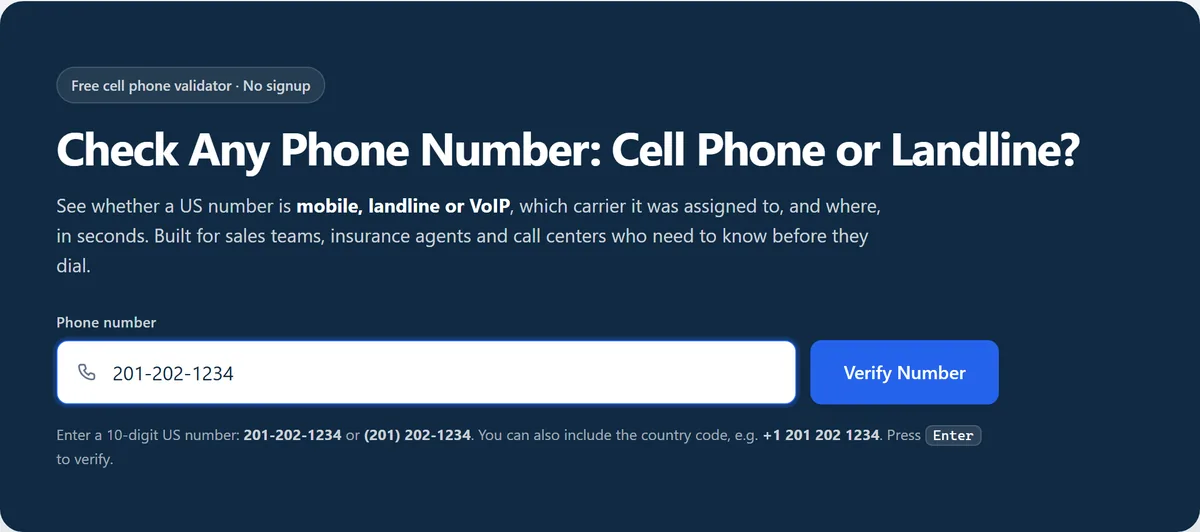
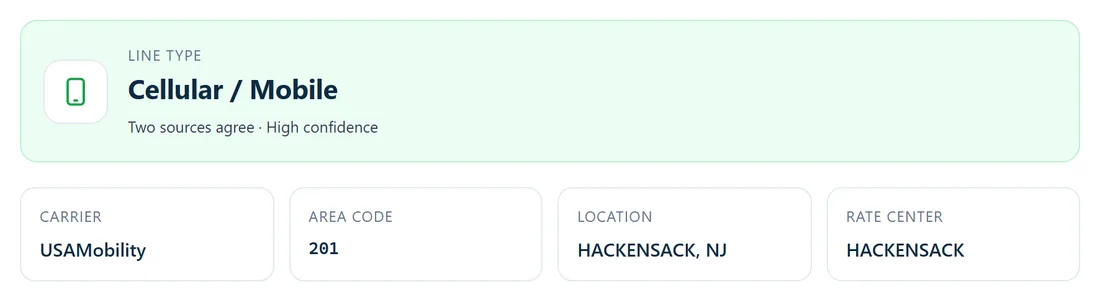
The quickest way is a free tool like the one on our homepage. Enter the number and you'll see the line type, the carrier and the location. It takes a few seconds and doesn't contact the phone.
2. Check more than one source
Allocation data comes from more than one registry, and they don't always match. Cellphone Validator checks two independent sources and only calls a number CELLULAR when both agree. If they disagree, you see a CONFLICT result with what each source said, instead of a guess.
3. Send a text
If a text is delivered, the number can usually receive SMS, which points to a mobile or a text-enabled VoIP line. This is slow, doesn't scale, and texting someone without consent can break the law, so it isn't practical for a call list.
4. Just call
You'll find out, but it's the most expensive way. It's also risky for cell phones if you use an autodialer or prerecorded message without consent.
What a lookup can and can't tell you
| A lookup can tell you | A lookup can't tell you |
|---|---|
| The type of service the number block was allocated for | Who owns or uses the number |
| The carrier the block was assigned to | Whether the phone is switched on right now |
| The state and rate center of the block | Where the person actually lives today |
| Whether two sources agree | Every port or reassignment since allocation |
The biggest limit is porting. Since 2003, people in the US have been able to keep their number when they switch carriers, including moving a landline number to a mobile phone. The block record still shows the original type. Read more in our guide to ported numbers.
Checking a whole list
For more than a few numbers, use bulk validation. Upload a CSV, and every number comes back labelled CELLULAR, LANDLINE, VOIP or UNKNOWN, with carrier and location. You can then export just the cell phones, or the full file with the new columns.
Frequently asked questions
Is there a free way to check if a number is a cell phone?
Yes. Cellphone Validator's single lookup is free and doesn't need an account.
Do cell phones in the US have special area codes?
No. US mobile numbers use the same area codes as landlines in the same region.
Why did a lookup say landline when it's really a cell phone?
The most common reason is that the number was ported from a landline carrier to a mobile carrier. The original block record still says landline.