Why the mobile number matters
Calling a company's main line gets you a receptionist or a phone tree. Calling a direct office line often gets voicemail, because many executives work remotely or move between meetings. A cell phone reaches the person directly. That's why sales teams pay more for data that includes mobile numbers.
Where sellers find decision makers' mobile numbers
- B2B contact data providers. Sales intelligence tools sell contact records with a "mobile" or "direct dial" field. Coverage and accuracy vary a lot by provider, industry and seniority.
- Email signatures. Many people put a cell number in their signature. Replies to your outreach, and out-of-office messages, are a good source.
- The prospect's own public pages. Founders and consultants often list a mobile on their website, booking page or public profile.
- Referrals and assistants. Asking a colleague or executive assistant for the best number is slower, but the number comes with context and often with permission to call.
- Your own CRM. Old deals, events and inbound forms often hold numbers nobody has labelled. Check what you already have before you buy more.
Whatever the source, treat the number as unverified until you've checked its line type.
Verify that the number is a cell phone before you dial
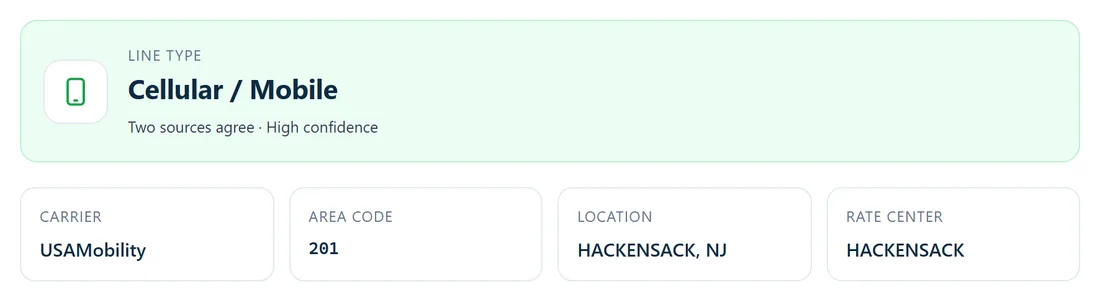
US cell phone numbers look exactly like landlines. The only reliable way to tell is to look up the block the number was allocated from. Cellphone Validator checks two independent allocation sources and only labels a number CELLULAR when both agree:
- One number: paste it into the free lookup. No account needed.
- A prospect list: upload a CSV to bulk validation, then export just the cell phones for your reps.
- Several providers: run each provider's export through the same check to see which one actually delivers mobiles. See phone data enrichment.
Why so many "mobile" fields are wrong
| What the record says | What it often is | How a lookup shows it |
|---|---|---|
| Mobile | A desk phone on the company's phone system | VOIP or LANDLINE |
| Direct dial | The main switchboard | LANDLINE or VOIP |
| Mobile | An old number the person no longer uses | CELLULAR (line type can't detect a change of owner) |
| Office | A landline number ported to a cell phone | CONFLICT |
A line-type check catches the first two cases, which are the most common. It can't tell you the number still belongs to the same person, so re-check older records and use the FCC Reassigned Numbers Database where consent matters. More on this in ported numbers and VoIP numbers.
Calling a decision maker's cell phone within the rules
The TCPA doesn't exempt business calls. A decision maker's cell phone is still a cell phone, so autodialed or prerecorded calls and texts to it need the right consent, while manually dialed calls are treated differently. Do-Not-Call rules can also apply when a cell phone is used for personal calls. Read the TCPA guide for sales teams and check your process with a compliance professional.
Frequently asked questions
Can Cellphone Validator find a decision maker's cell phone number?
No. It verifies numbers you already have, from a data provider, a signature or your CRM, and tells you which are cell phones, landlines or VoIP lines.
How can I tell if a B2B number is a mobile or a desk line?
Look it up. US mobile and office numbers share area codes, so you can't tell from the digits. A line-type lookup shows whether the number block is wireless, landline or VoIP.
Is it legal to cold call a decision maker's cell phone?
Manually dialed B2B calls are generally treated differently from autodialed or prerecorded ones, which need consent for cell phones. Rules vary by state and situation, so this is not legal advice.